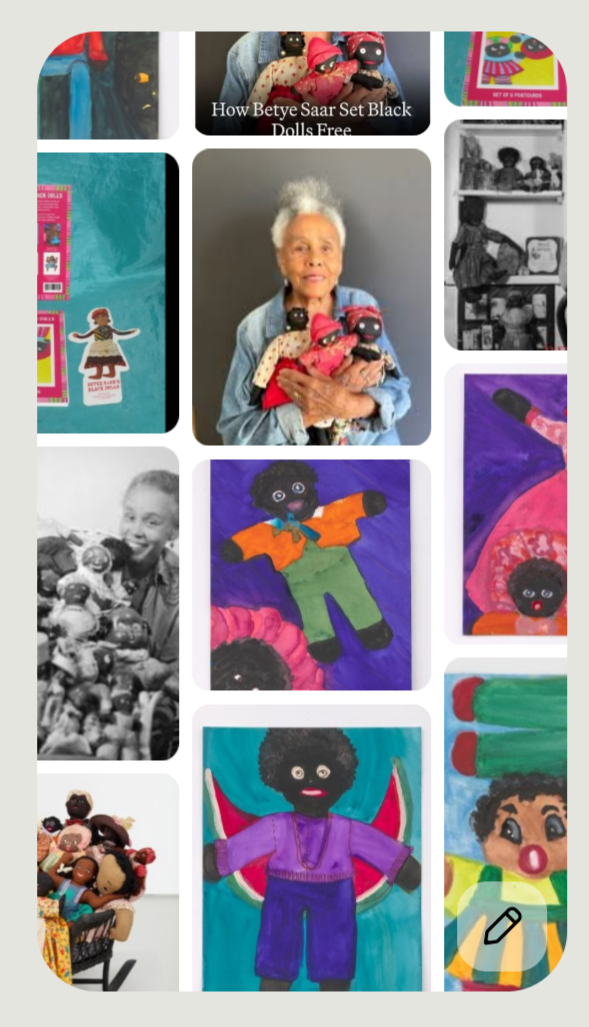
It is with profound sadness that DeeBeeGee’s Virtual Black Doll Museum acknowledges the passing of Betye Saar, the pioneering assemblage artist, collector, and influential figure in the Black Art Movement, who died on July 26, 2026—just four days shy of her 100th birthday.
Betye Saar was not a Black-doll artist by profession. She was, however, a collector of Black dolls and recognized the power and meaning that these objects could hold within Black history, culture, memory, and identity. In fact, she created only one doll during her lifetime. Her appreciation for Black dolls is nevertheless an important part of the story of an artist whose work so profoundly engaged with the imagery and representations of Black people.
Saar became renowned for transforming found objects, historical artifacts, and racist imagery into powerful assemblages. Rather than allowing degrading stereotypes of Black people to remain symbols of oppression, she reclaimed and recontextualized them as symbols of resistance, strength, dignity, and Black empowerment.
Perhaps her most celebrated example is The Liberation of Aunt Jemima (1972), in which Saar transformed the stereotypical Aunt Jemima image into a figure of resistance and power. Her work challenged the racist visual language that had been used to demean Black people and, particularly, Black women.
Saar was an important participant in the Black Art Movement, and her influence extends far beyond the gallery walls. Through her art, she confronted racism, stereotypes, history, spirituality, memory, and the complex ways Black people have been represented in American culture. Her assemblages encouraged us to look again at objects and images that society had accepted for generations—and to see their histories and meanings differently.
For those of us who collect, study, preserve, and celebrate Black dolls, Betye Saar’s legacy holds particular resonance. Black dolls are not merely objects of childhood or collectibles; they can also be vessels of memory, cultural representation, history, and identity. Saar understood the power of objects to tell stories.
A Lasting Gift to Black-Doll History
Just months before her passing, Betye Saar made an extraordinary contribution to the preservation of Black-doll history when she donated her collection of more than 100 Black dolls to The New York Historical. This remarkable collection is now being celebrated in Betye Saar’s Black Dolls, an exhibition honoring her centennial and exploring the historical, personal, and cultural significance of Black dolls. The exhibition is on view through October 4, 2026.
The collection reflects Saar’s decades-long interest in Black dolls and includes handmade dolls, mass-produced dolls, and figures that embody both the richness of Black representation and the painful history of racist stereotypes. Among them is Hoo Doo Woman (1974), the only Black doll Saar designed and created herself.
What a beautiful and fitting legacy: as Betye Saar approached her 100th birthday, she ensured that these dolls—and the stories, memories, history, and cultural meaning they carry—would be preserved for generations to come.
As we mourn her passing, we celebrate a remarkable woman whose creative vision challenged stereotypes and transformed the meaning of objects that others might have overlooked or discarded.
DeeBeeGee’s Virtual Black Doll Museum extends our deepest sympathy to Betye Saar’s family, friends, fellow artists, collectors, admirers, and to all who knew and loved her and her extraordinary art.
May Betye Saar’s memory be a blessing, and may her powerful artistic legacy continue to inspire generations to reclaim, reinterpret, create, and empower.
Rest in power, Betye Saar.
July 30, 1926 – July 26, 2026
Related Links
Betye Saar, The Liberation of Aunt Jemima
Saar discusses The Liberation of Aunt Jemima
Betye Saar’s Black Dolls at The New York Historical


