
Name: Topsy Turvy Dolls (Various)
Made by and When: Madame Alexander and unknown others, 1930s-1950s and ca. 2023
Material: The 1930s Madame Alexander Topsy Turvy is made of composition. The dolls from the 1940s and the 2023 doll are made of cloth. The 1950s Brazilian souvenir Topsy Turvy is made of felt.
Marks: Unmarked but commercially produced by different manufacturers; the Antigua souvenir doll has a hang tag that reads, “I am a Caribbean Reversible Doll.”
Height: 7-1/2 inches (Madame Alexander); 10 inches (1930s cloth doll), 11 inches (1940s and Antigua dolls) and 12 inches (1950s Brazilian souvenir)
Hair, Eyes, Mouth, Clothes, and Accessories (Black and White dolls, respectively):
1930s Madame Alexander Topsy Turvy

Hair, Eyes, and Mouths: Three tufts of black yarn accented with red ribbons create pigtails. The rest of the head is painted black. The White doll has sculpted brown hair. Both have painted black eyes and closed mouths with red lip color.
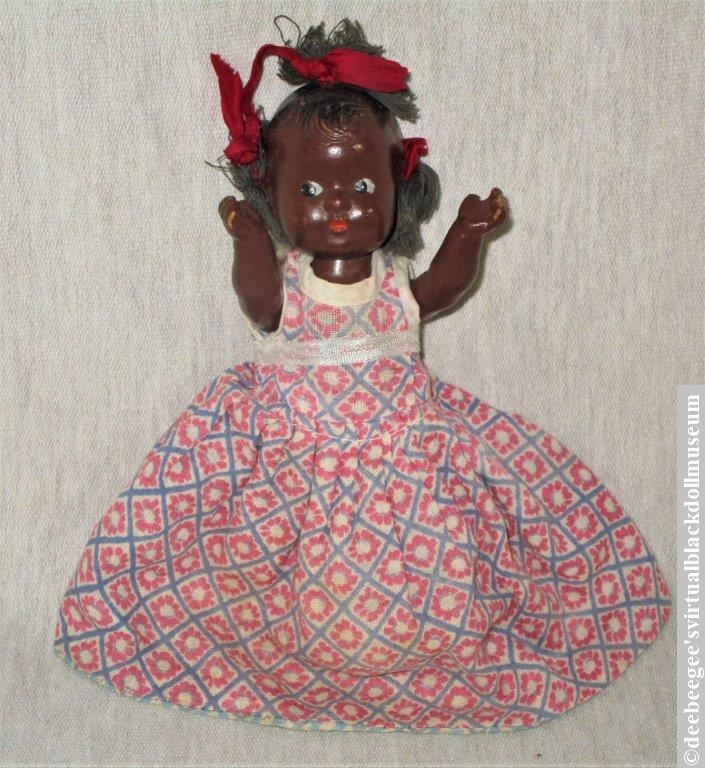

Clothes: (Black) Wears a red, white, and blue floral-print dress with a ribbon tied at the waist; (White) floral print dress in light blue, white, and gray with a light blue ribbon tied at the waist; both dresses are closed with a pin in the back.
1930s Topsy Turvy Doll
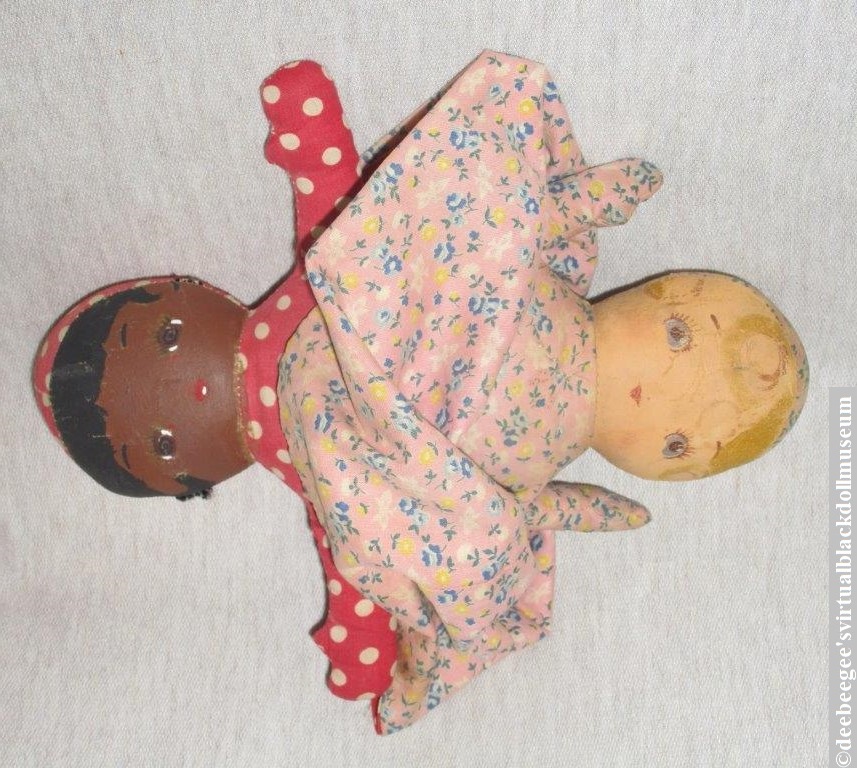
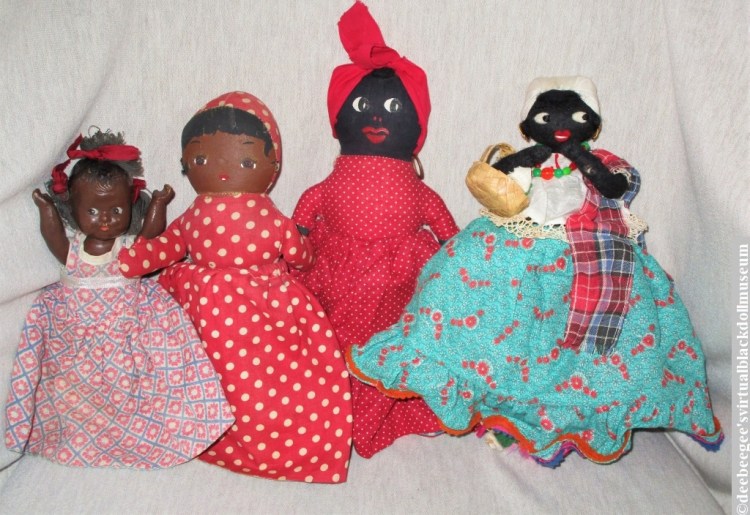
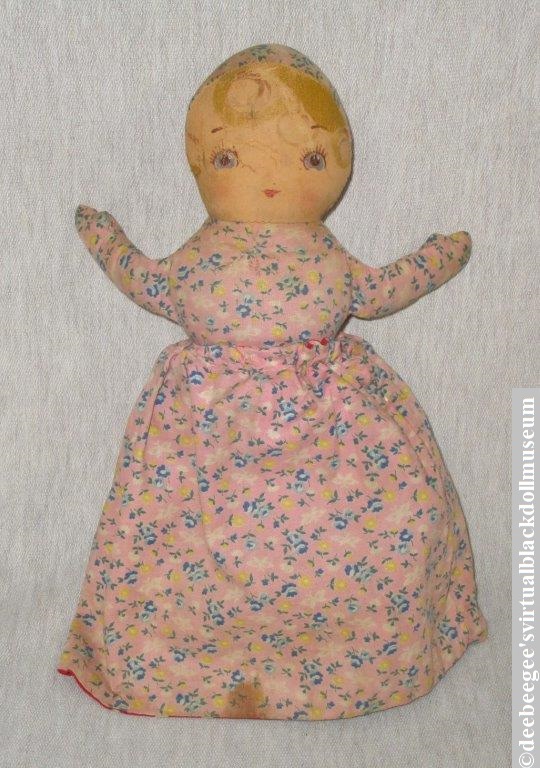
Hair, Eyes, and Mouths: Painted black hair and sewn-on red and white polka dot cap; painted blonde hair that has faded with time and a pink floral-print sewn-on cap; both dolls have screen-printed painted facial features. The Black doll’s entire face has been repainted.*


Clothes: (Black) Red and white polka dot long-sleeve top sewn to the cloth-stuffed body and a red and white polka dot full-length skirt; (White) pink floral long-sleeve top sewn to the cloth-stuffed body with a full-length skirt of the same fabric; the top fabric extends to the dolls’ hands to create mitten hands.
1940s Topsy Turvy Doll

Hair, Eyes, and Mouths: Black yarn bangs, the rest of the head is covered with a red headscarf. Yellow yarn hair is underneath a blue and white gingham bonnet. The Black doll’s face is painted. The white doll’s face is screen-printed.
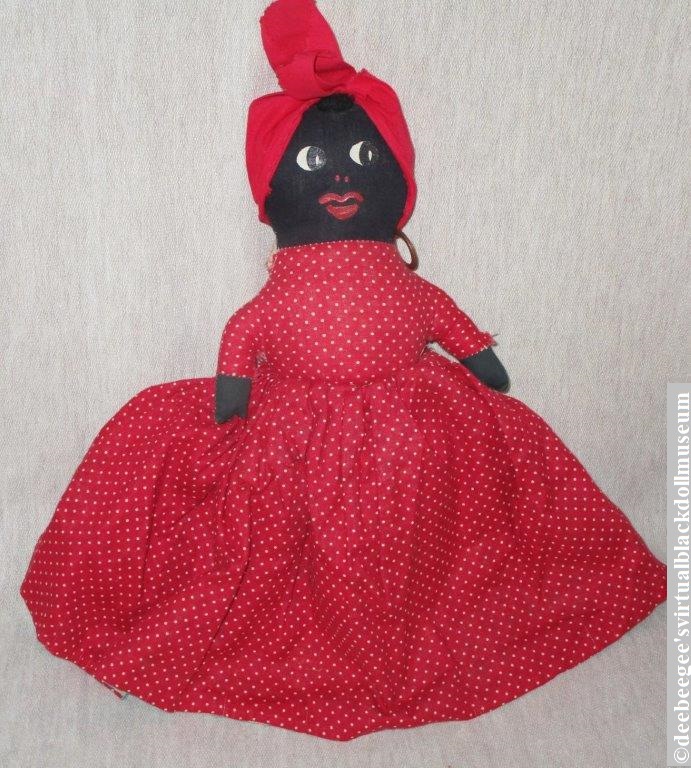
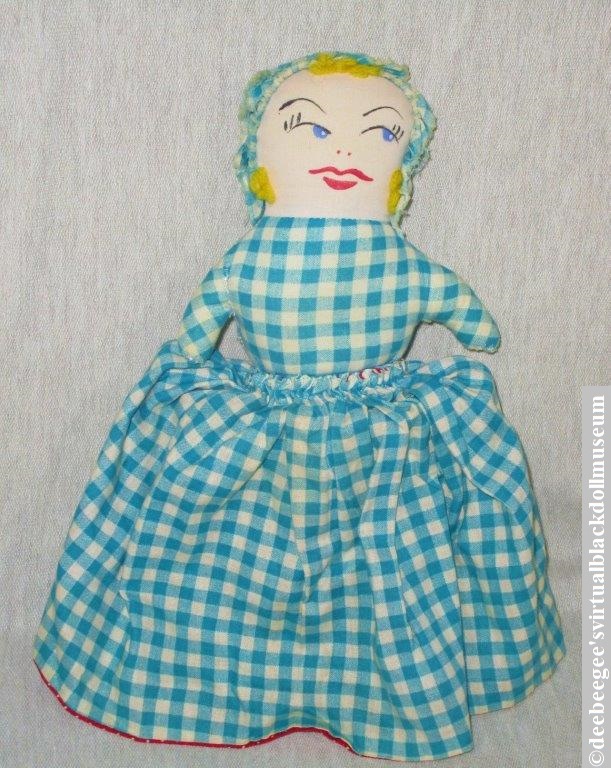
Clothes: (Black) Sewn-on small red and white polka dot blouse and matching full-length skirt; has black-cloth mitten hands. (White) Sewn-on blue and white gingham top and matching full-length skirt; has blue and white gingham mitten hands.
1950s Brazilian Souvenir Topsy Turvy

Hair, Eyes, Mouths: The 1950s Brazilian souvenir Topsy Turvy is the only doll in this installation with a deep complexion on both sides, one deeper than the other. The deepest complexioned doll has black felt bangs underneath a white cloth turban. The medium-brown complexioned doll has black synthetic bangs under a blue satin scarf with an attached fruit basket. Made of felt, both dolls have side-glancing black eyes with white sclerae and red heart-shaped lips. White thread is stitched across the mouth of the doll with the deepest complexion.
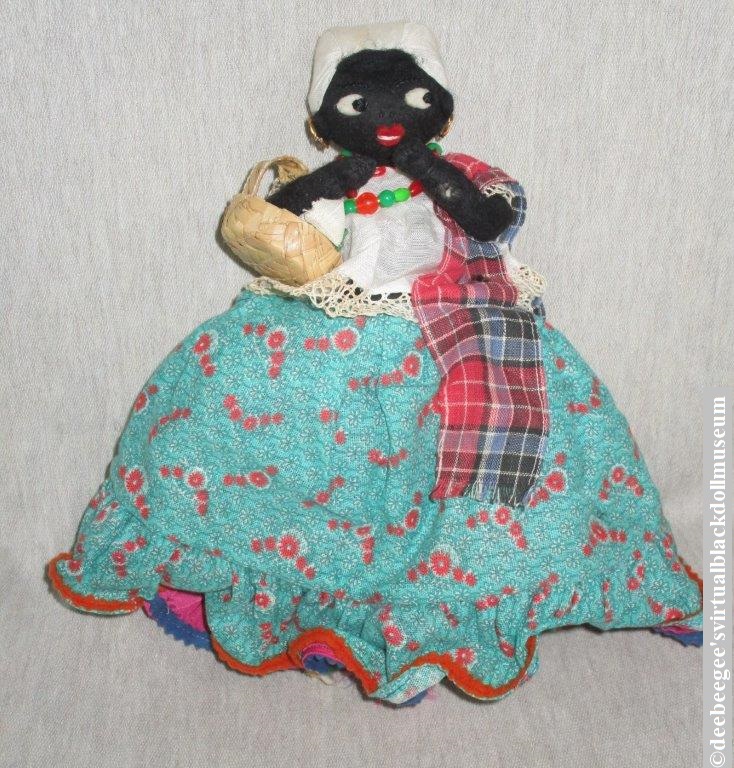

Clothes: The Black doll wears a white satin headscarf, a madras plaid shawl, a white satin blouse with lace trim, and a cotton floral-print skirt with a ruffled hem. Accessories for the Black doll include gold-tone hoop earrings, a plastic multicolored beaded necklace, and a head basket with a white cloth inside. The medium-complexioned doll wears a white lace blouse with a Madras plaid shawl and a pink satin skirt accented at the hem with felt flowers. This more elaborately dressed doll wears gold dangle hoop earrings and a gold necklace with a gold hand-shaped pendant, a figa—a symbol of good luck in the Afro-Brazilian culture. (Its meaning varies in other cultures.) The medium-complexioned doll is adorned with gold bracelets and a multicolored plastic beaded necklace.
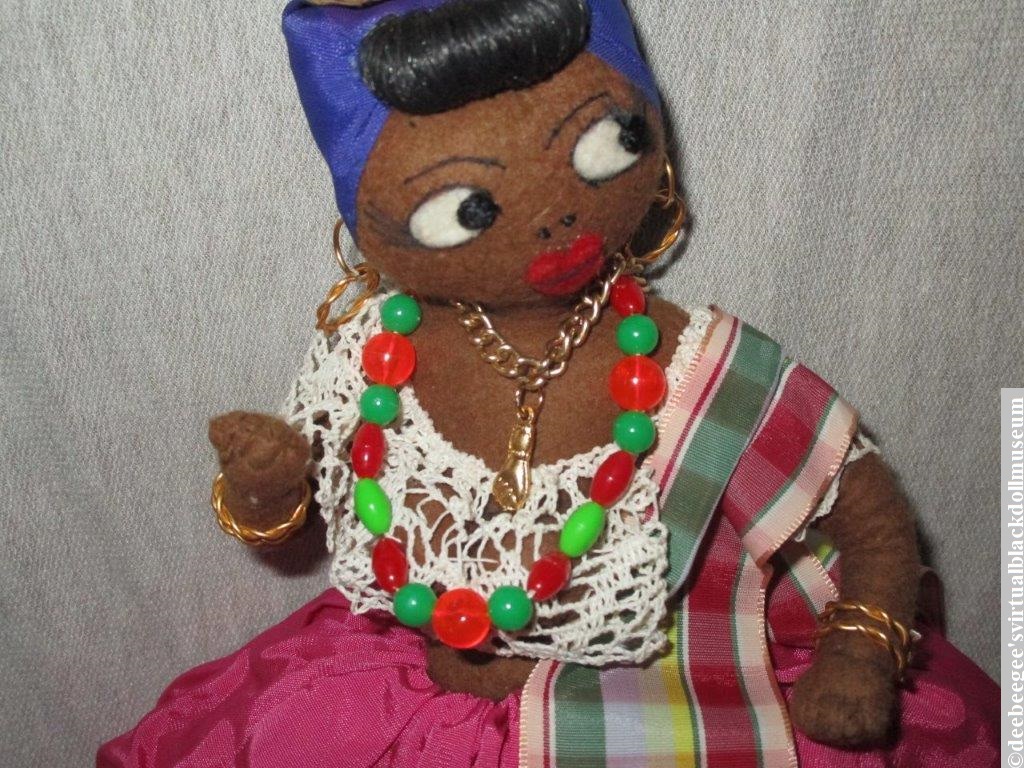
Brazilian Topsy Turvy Comparison: The clothes and accessories of the commercially-produced medium-brown complexioned Brazilian Topsy Turvy are more elegant than the attached doll’s clothing. The brown doll has silky bangs; the Black doll’s bangs are coarse with the rest of the head covered by a headscarf. The medium-brown complexioned doll wears a symbol of good luck. The Black doll does not. While they are not Black and White, the clothing and accessories of the medium-brown Brazilian Topsy Turvy suggest it is superior to the Black doll. This Topsy Turvy illustrates the battle of colorism that still exists within many cultures where the erroneous assumption exists that lighter skin is more attractive.
2023 Antigua Topsy Turvy (Caribbean Reversible Doll)

Hair, Eyes, Mouths: Both dolls wear tignons. The doll with the madras plaid skirt has a bun fashioned with black yarn. Their hand-painted faces are identical and include heart-shaped lips. Their brown cloth complexions are the same copper brown.
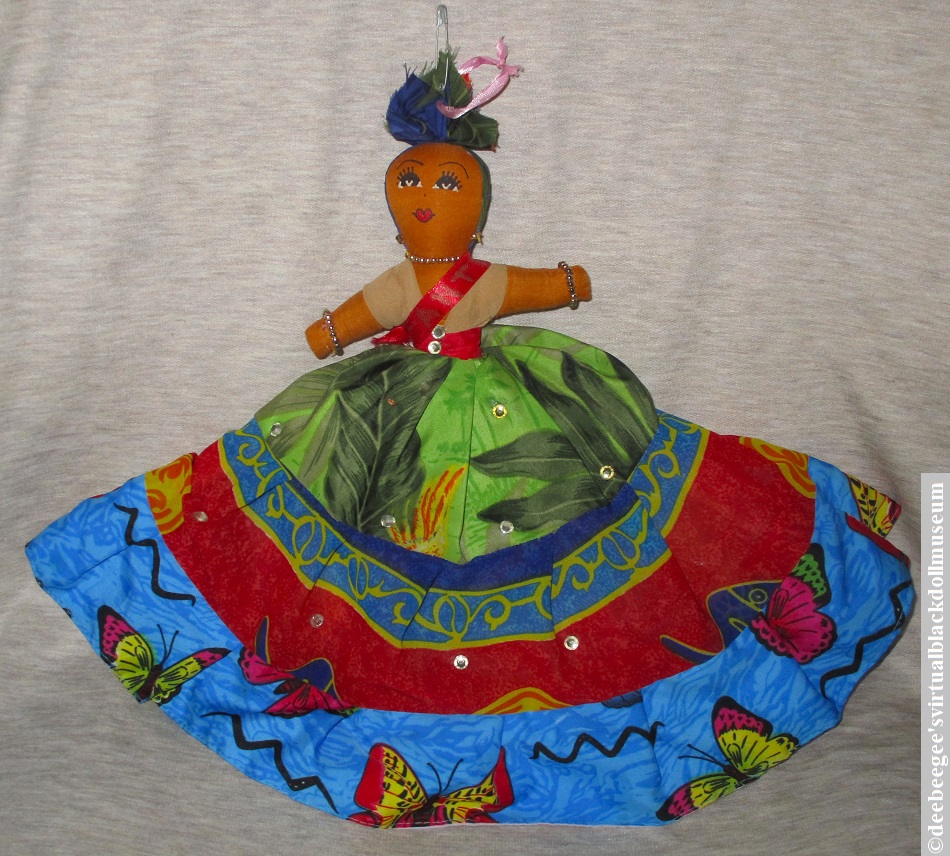
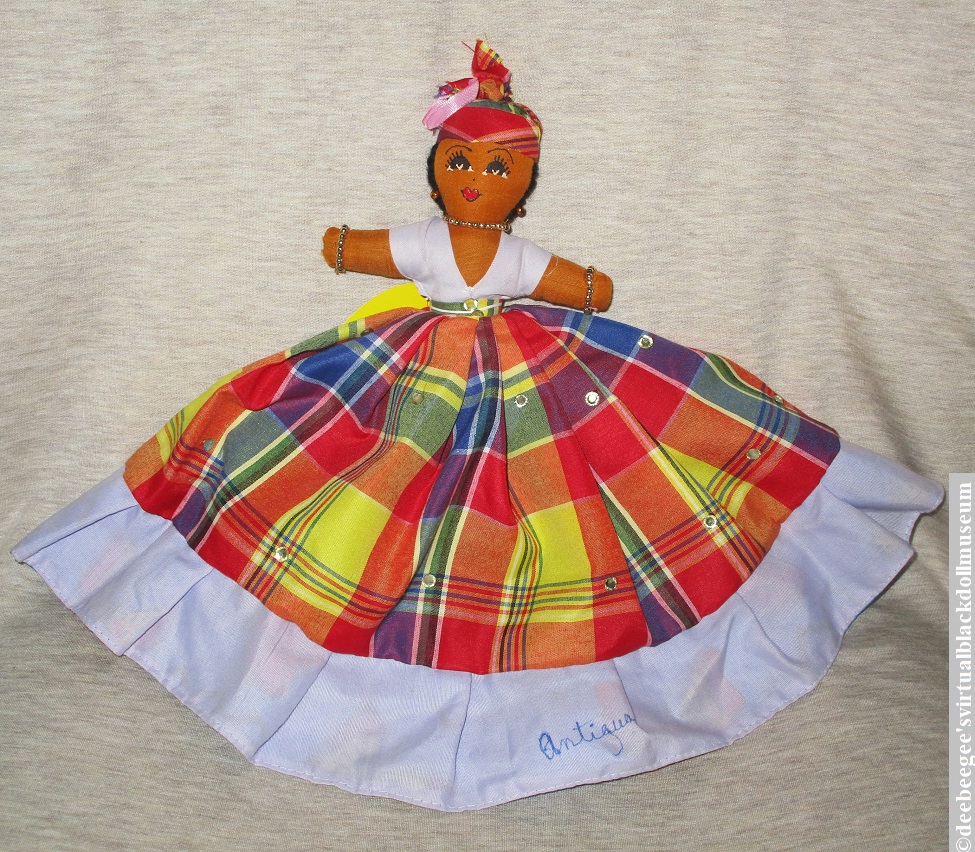
Clothes/Accessories: (Left) The dress has a tan bodice and a red satin ribbon sash that reads Antigua. The cloth of the attached skirt is a floral print embellished with rhinestones. The ruffled hem is made of butterfly-print fabric. (Right) The dress has a white bodice with an attached rhinestone-embellished Madras plaid skirt that has a lavender ruffled hem. “Antigua” is written in cursive on the center of the hem. (Both) Accessories include gold-tone beaded necklaces, matching bracelets, and beaded earrings.
Other: Dating back to the antebellum South, the first Topsy Turvy or double-sided dolls are attributed to the ingenuity and handwork of enslaved Black American women. “Among the most unusual and prized folk dolls is the Topsy Turvy doll, which originated in the antebellum South” (Buster 129-130). Other than the existence of the dolls and oral history, these women, who were forbidden to read and write, were incapable of creating a written account of their design as the first double-sided dolls (typically a Black doll on one side and a White doll on the other).
Two known concepts behind Topsy-Turvy dolls exist. 1) An enslaved child played with the White side in the absence of their enslaver. Upon the enslaver’s approach, the enslaved child flipped the doll over to the Black side to hide the forbidden-to-play-with White doll. Others postulate that enslaved women made Topsy-Turvy dolls for White children who were forbidden to play with Black dolls. In the absence of their parents, the White child played with the Black doll and flipped it to the White side upon their parents’ or other disapproving person’s approach.
The original double-sided dolls were later named Topsy Turvy by companies that commercialized and profited from the design of Black women. Albert Bruckner and E. I. Horsman are two early manufacturers of Topsy Turvy dolls where the concept continued of two dolls (without legs) with one torso and a long skirt that hides the head and arms of the doll underneath the skirt. For most commercially-produced Topsy Turvy dolls, the White doll is often more elaborately dressed and portrayed as a person of superior status while the Black doll is typically dressed to depict a servant.
Excluding the Antigua and Brazilian souvenir dolls, all Topsy Turvy dolls in this installation depict a White doll on one side and a Black doll on the other. The headscarf worn by the 1940s doll depicts the Black doll as a servant. The other Black and White Topsy Turvys in this installation are dressed similarly and appear to have equal standing.
Slideshow




References
Buster, Larry Vincent. The Art and History of Black Memorabilia. Clarkson Potter, 2000.
“Brazilian Figa.” Your Story Tenement, https://yourstory.tenement.org/stories/brazilian-figa. Accessed 16 Sept. 2022.
Additional Topsy Turvy Articles and Installations
Topsy Turvy a.k.a Topsy-Turvey, Double Doll, Two-Sided Doll
UFDC’s Topsy Turvy DVD Presentation
Topsy and Eva Babyland Topsy-Turvy
_________
Your comments are valued. Donations aid the initiative to preserve Black-doll history.
If you subscribe to DeeBeeGee’s Virtual Black Doll Museum™ by email, click the post title in the email, which links to the website to view all text and associated media. Please “like” and share this installation with your social media contacts. Add your email address to the subscribe or sign-up field in the footer or right sidebar.
 DeeBeeGee's Virtual Black Doll Museum™
These are just wonderful! I have a cloth Black/White topsy turvy, but I had not seen a composition one. What a great collection.
LikeLike
Thank you, Ann!
LikeLike