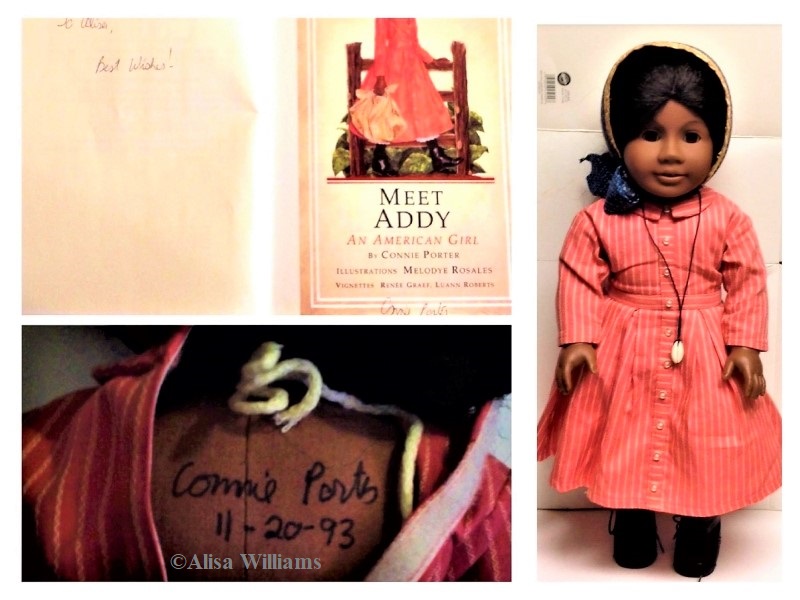
Photographs courtesy of Alisa Williams
Name: Addy Walker 1864
Made by and When: Pleasant Company, 1993
Material: Vinyl with brown cloth body
Marks: ©PLEASANT COMPANY /148 / 16
Height: 18 inches
Hair, Eyes, Mouth: Dark brown textured Kanekalon wig styled in a loose French braid, dark brown sleep eyes, smiling mouth with two upper teeth
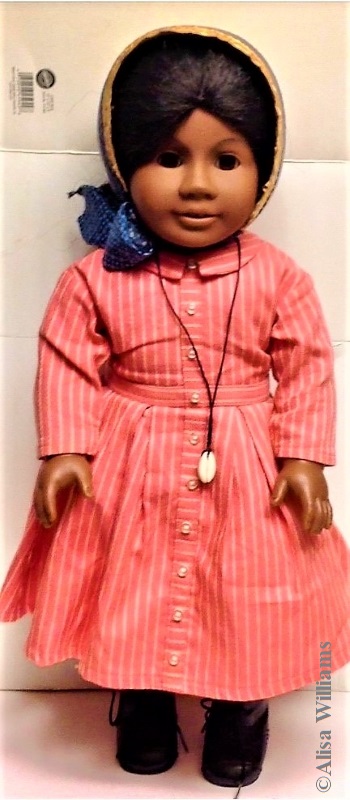
Clothes: Original pink striped “Meet Dress,” white lace-trimmed pantaloons, black knee-high stockings, black lace-up boots, and navy-blue satin hair ribbon; the doll shown wears the first-edition, separately-sold bonnet and cowrie shell necklace, and holds a knotted beige printed kerchief inside of which is a water gourd and a half-dime.
Other: From the original Historical Dolls Collection, Addy represents a former enslaved girl who escapes to freedom with her mother in 1864 by traveling on foot and by ship with the help of safe houses and abolitionists from North Carolina to Philadelphia. Meet Addy is the first in a series of books about Addy Walker, the first of which were written by Connie Porter (who signed the doll and book shown). Addy’s first book was illustrated by Melodye Rosales, Dahl Taylor, Renée Graef (vignettes), and Luann Roberts (vignettes). Several mini versions of Addy have been made and several separately-sold accessories and clothing based on the 18-inch doll’s theme were produced.
The following advisory team of seven African American scholars, and experts guided the development of the doll, clothing, and stories:
- Lonnie Bunch: Smithsonian curator (later founding director of the NMAAHC).
- Spencer Crew: Historian and curator.
- Violet Harris: Expert in Black American children’s literature.
- Wilma King: Historian specializing in American slavery.
- Cheryl Chisholm: Producer and director.
- Janet Sims-Wood: Librarian/scholar specializing in Black women’s history.
- June Powell: Expert from the National Afro-American Museum and Cultural Center.
Reference: Addy Walker Wiki
_________
Your comments are valued. Donations aid the initiative to preserve Black-doll history.
If you subscribe to DeeBeeGee’s Virtual Black Doll Museum™ by email, be sure to click the post title in the email, which links to the website to view all text and associated media. Please “like” and share this installation with your social media doll contacts. To subscribe, add your email address to the subscribe or sign-up field in the footer or right sidebar.
 DeeBeeGee's Virtual Black Doll Museum™