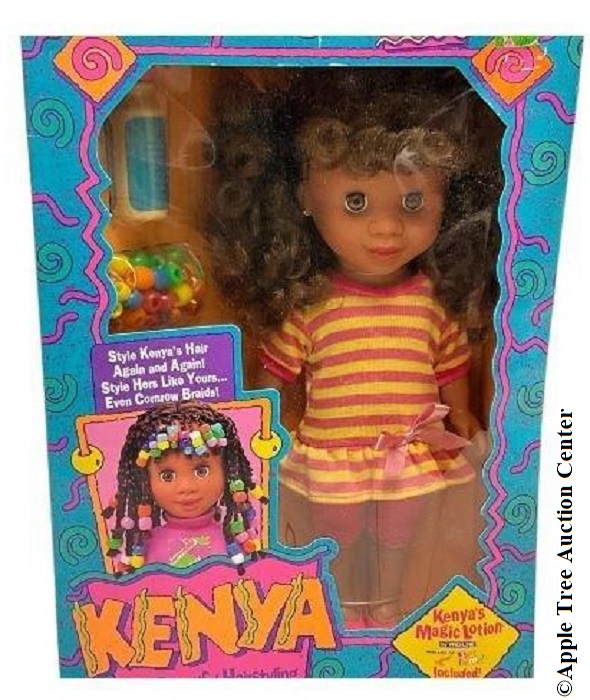
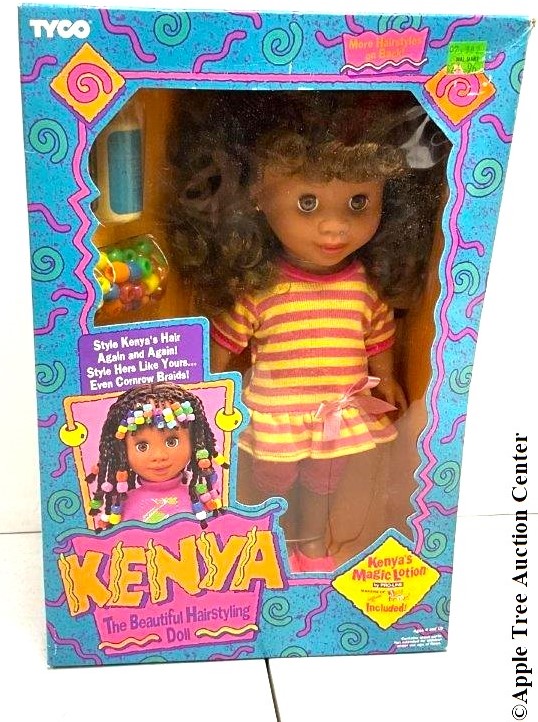
Name: Kenya the Beautiful Hair Styling Doll
Made by and When: Tyco, 1992
Material: Vinyl, synthetic hair, acrylic eyes, plastic, rubber, hair styling solution
Complexion: Light (medium and deep skin tones were available).
Marks: (Head) ©1991 TYCO IND., INC. / MADE IN CHINA
Height: 13 inches
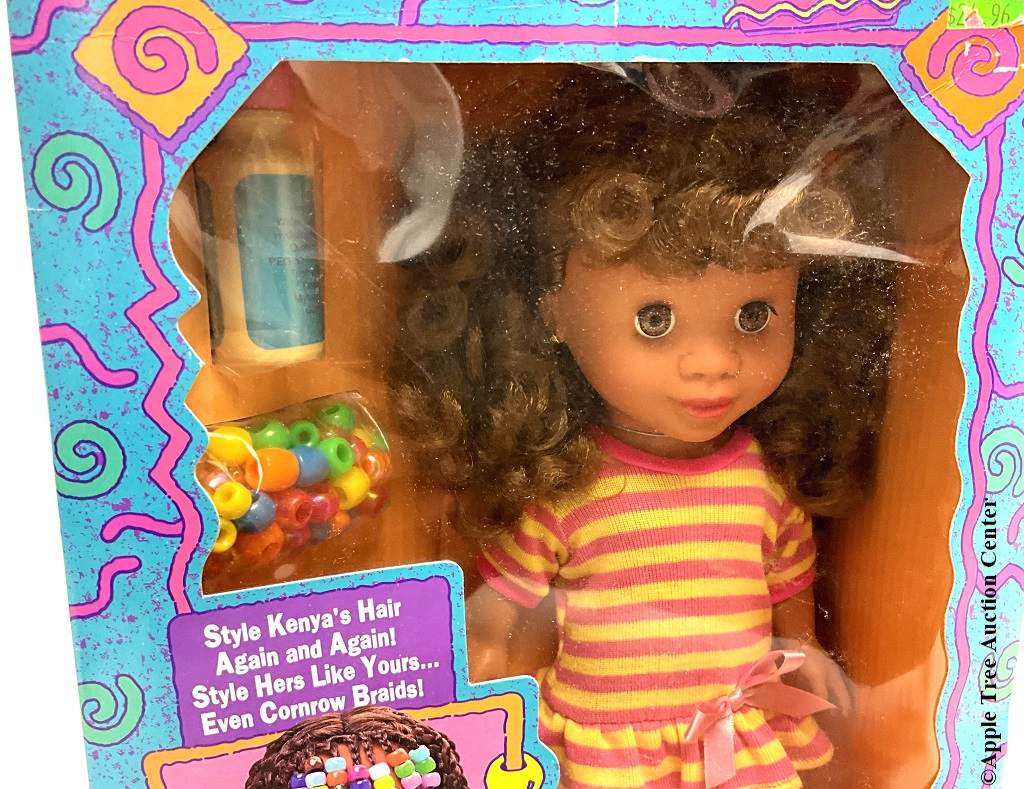
Hair, Eyes, Mouth: Curly-textured, reddish-brown rooted hair (dolls with dark brown and black-rooted hair were made). Kenya has brown inset eyes with attached upper eyelashes. The mouth is closed. The head mold features distinct African American features.
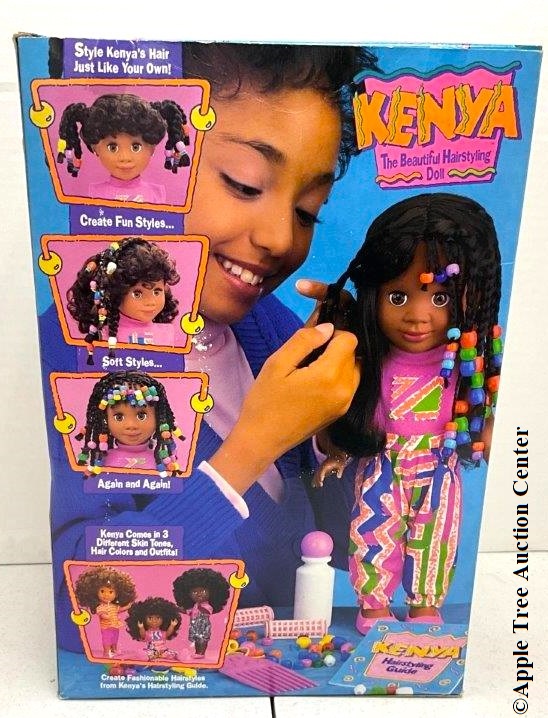
Clothes/Accessories: The yellow and pink romper has a striped top with a ruffled hemline and attached knee-length pink pants, wears pink vinyl shoes; has pierced ears with gold-tone earrings. Accessories include a hair pick, hair beads, rubber bands, curlers, a bottle of Pro-Line styling lotion, and a hairstyling guide.
Other: Kenya the Beautiful Hair Styling Doll by Tyco (designed by toy inventor Ruth Golden-Morace) is one of the first mass-marketed dolls whose entire concept—appearance, hair play, marketing, and message—was built around Black identity (hair texture, color, and styling; and skin tones that represent the diversity of the African American appearance) rather than adapting an existing white doll design. Tyco partnered with Pro-Line—a pioneering ethnic hair care brand founded in 1970 by Comer Cottrell in Dallas, Texas—to include a hairstyling lotion for styling Kenya’s hair. Tyco’s original doll helped create fond doll-playing memories for Black girls and paved the way for other doll companies to offer Black dolls with a wider variety of skin tones, hair colors, and textures.
In 1994, Tyco expanded the Kenya line with Kenya’s Beautiful Sister Simone, an 11-1/2-inch fashion doll. Six-inch Kenya’s Cousins (Little African Princesses dressed in African-print clothing) were also introduced in 1994. These collections also featured different skin tones and hair styling lotions.
From 2003 through 2016, other companies reintroduced the 13-inch Kenya. These include dolls by Uneeda (2003), Kenya’s World, LLC. (2012), and Golden-Morace’s SmartZone company’s reintroduction of the original Kenya in 2016.
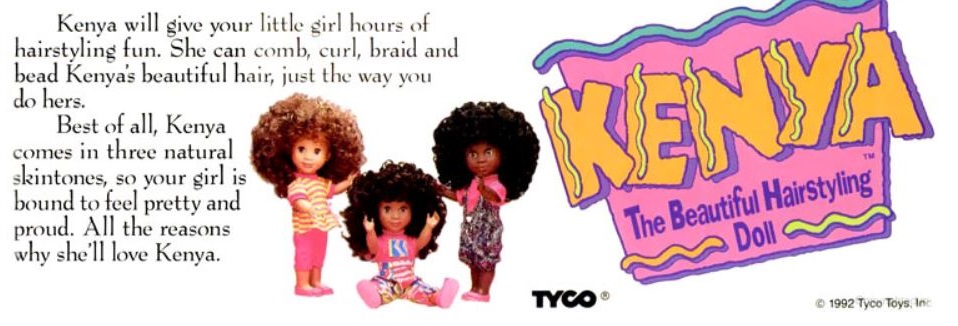
Gallery (The doll photos are courtesy of Apple Tree Auction Center. The last gallery image is a partial scan of a 1992 Kenya ad; it illustrates the three skin tones and hair colors.)
References
Cottrell, Comer Joseph. “Comer Joseph Cottrell.” The HistoryMakers, https://www.thehistorymakers.org/biography/comer-joseph-cottrell-40. Accessed 17 Mar. 2026.
Kenya and Friends (Ruth Golden-Morace’s reintroduction)
Kenya Commercial in an Instagram post with comments from former owners
Kenya Commercial with Slides in an Instagram post by Because of Them We Can.
_________
Your comments are valued. Donations support the initiative to preserve Black-doll history.
If you subscribe to DeeBeeGee’s Virtual Black Doll Museum™ by email, click the post title of the email, which links to the website to view all text and associated media. Please “like” and share this installation with your social media contacts. If you’d like to subscribe, add your email address to the subscribe or sign-up field in the footer or right sidebar. Add your email address to the subscribe or sign-up field in the footer or right sidebar.
 DeeBeeGee's Virtual Black Doll Museum™