Name: Simon & Halbig #1358 (Reproduction)
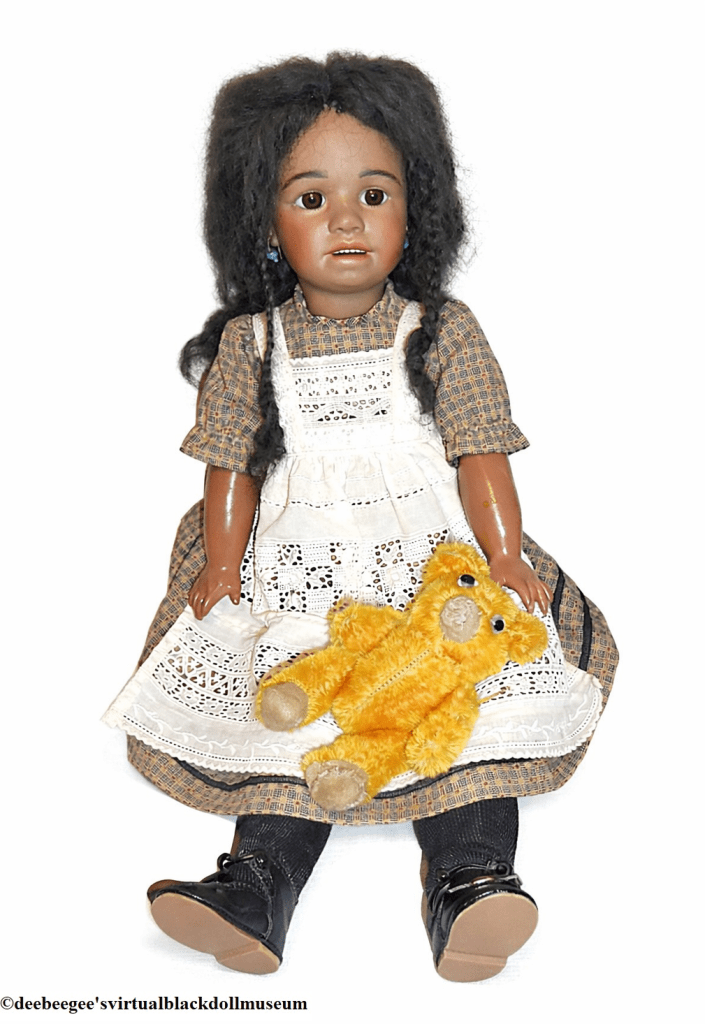
Made by and When: Andrea Salkowe under the instruction of Enid Santarcangelo, ca. 1990
Material: Bisque head, jointed composition body
Marks: 1358 / Germany / Simon & Halbig / S&H / 8 / Enid Santarcangelo
Height: 17 inches
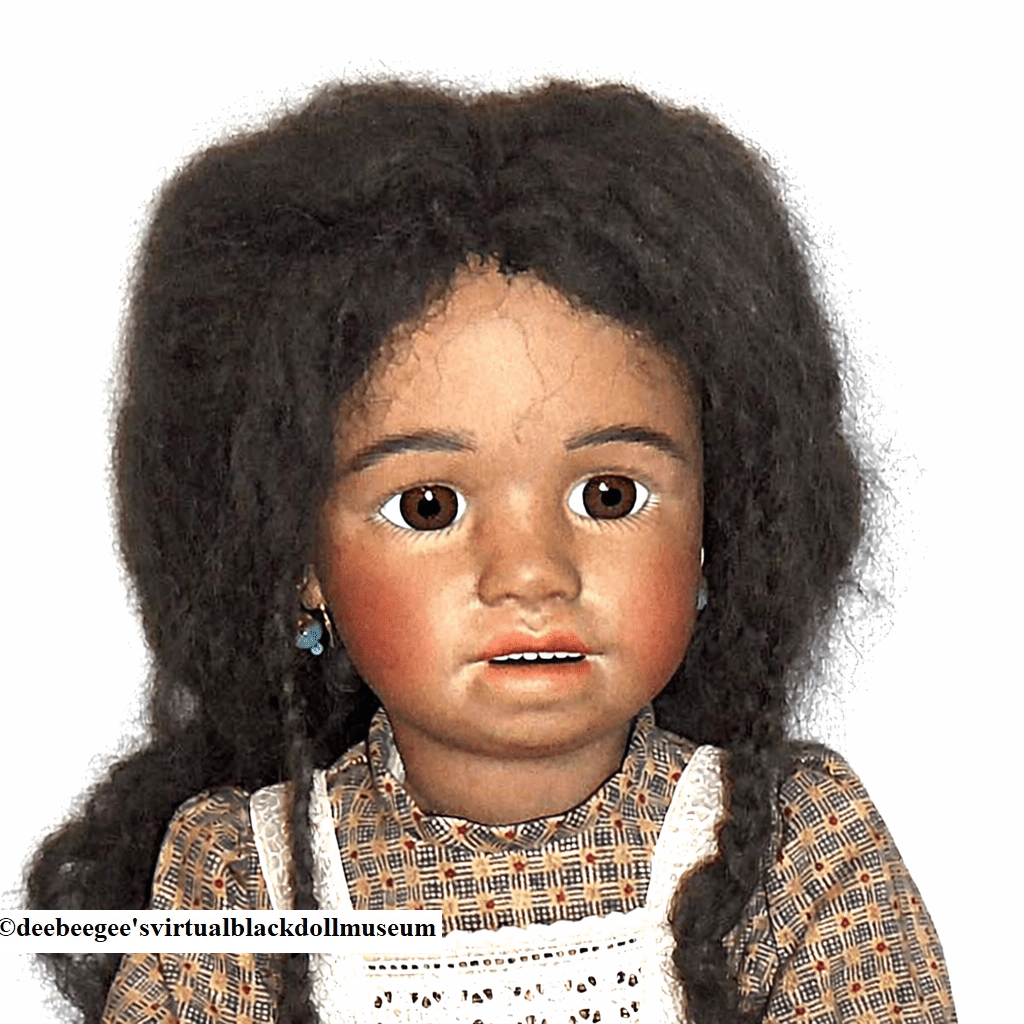
Hair, Eyes, Mouth: Aged black mohair wig, brown glass eyes, open mouth with six carved teeth
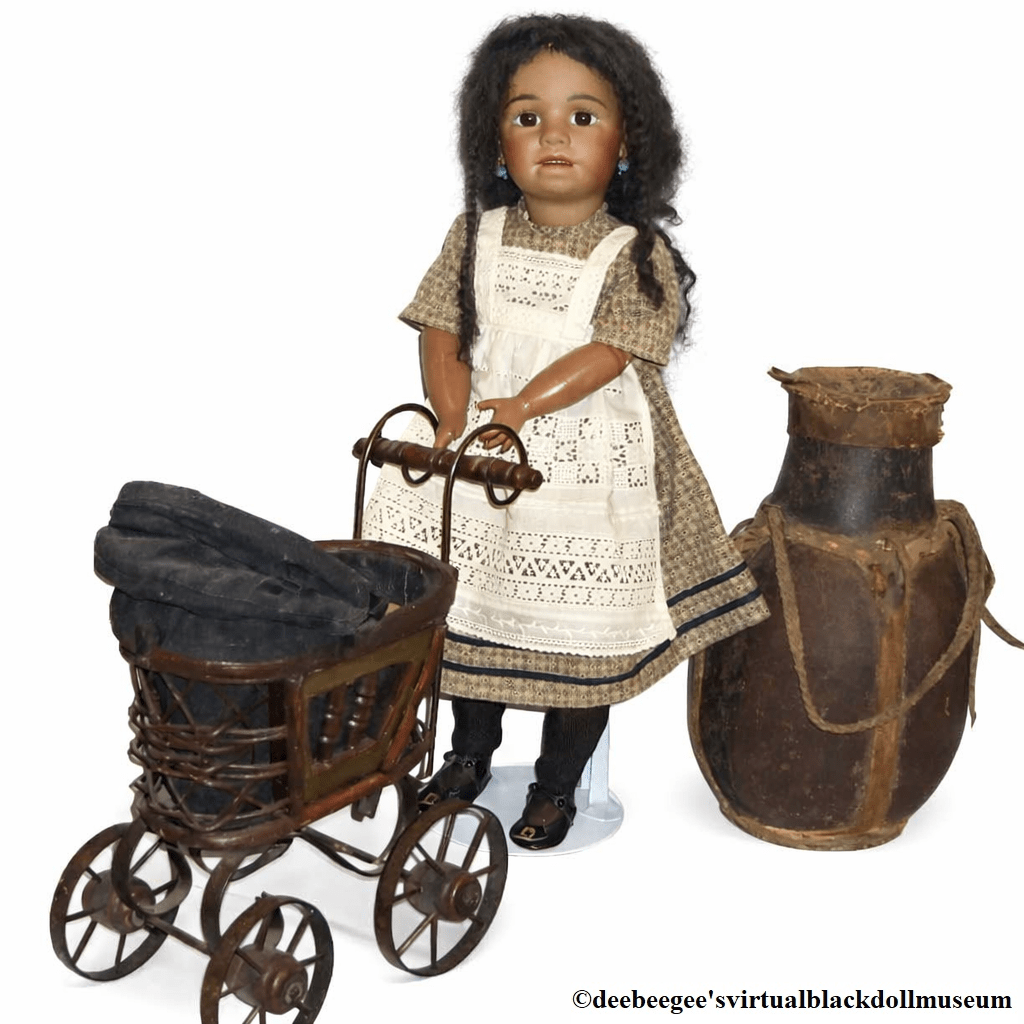
Clothes: Wears antique turquoise earrings with a period-appropriate brown and tan dress with an off-white lacy apron, one-piece undergarment, black full-length socks, and black leather shoes with buckles on the forefoot. Has an antique jointed mohair teddy bear.
Other: According to an Antique Trader article (no longer accessible online), “German dollmakers Wilhelm Simon and Carl Halbig produced high-quality bisque doll head molds, all-bisque dolls, and bisque lower arms and legs for dolls from 1869 through 1920.” Many of their molds were used by other doll companies and are used by independent doll artists in modern doll-making.
Antique character dolls with light brown complexions were often classified as mulatto. This outdated term originated during the 16th century in Portugal and was widely used during the Atlantic slave trade when referring to a child with one Black parent and one White parent. Because of the lighter shade of brown used to paint the doll, mulatto, as a descriptive term was used by early European doll makers. This mold is classified as a character doll because it was sculpted to look like a real child, as opposed to the typical dolly face widely used for dolls.
Provenance: In 2013, the doll’s artist described it as follows:
This is a wonderful 17” reproduction of Simon and Halbig mold #1358. This mold is hard to find in a real antique, which would sell for $11,000. So she is the next best thing. She comes with her antique jointed mohair bear… She is made from white bisque tinted with many firings to get the soft brown color that has depth and shading to make it look old. You can see, for instance, how I shaded around the nose and under the lip. She has feather-stroked black eyebrows painted using many pictures of antique dolls. We carved her 6 teeth out of the clay itself! She has full lips, very well shaded to give them depth, [and] German glass brown eyes. She is very appealing. I made her wig from thick, soft black mohair, which I had left to fade a bit on a windowsill to get the aged appearance. She is on a brown Seeley jointed German body appropriate for her. She has on antique turquoise earrings, [a] beautifully made cotton dress with lace apron, also a tea-dyed pantaloon onsie undergarment that is very sweet and buttons above the bottom! She wears antique stockings and great leather black shoes with buckles. She is signed by my teacher, who helped me clean and fire the bisque. Also marked 1358/German/Simon and Halbig/S&H/8.
After the doll’s acquisition in 2013, the artist was asked to share her history as a doll-maker; how long she had been making dolls, if this was her first brown S&H, and what inspired her to make it? She replied:
I started making dolls 20 years ago. I haven’t made any in the past few years as I have gone back to painting. I was a professional painter of large oils and prints. I found dolls and started repairing and painting them with a great teacher friend. They helped me with my restoration skills, and I enjoyed so much creating them. I made this black Halbig for many reasons. I loved the mold and was very challenged by cutting the teeth out of the clay as opposed to other dolls I saw that inset them behind the lips. I also liked making her from white bisque with many layers of tinting to create the skin tone… So often, brown bisque is used, which is not how the originals were created and leads to a flat appearance.
Gallery
See an original S&H 1358 here.
_________
Your comments are valued. Donations support the initiative to preserve Black-doll history.
If you subscribe to DeeBeeGee’s Virtual Black Doll Museum™ by email, click the post title of the email, which links to the website to view all text and associated media. Please “like” and share this installation with your social media contacts. If you’d like to subscribe, add your email address to the subscribe or sign-up field in the footer or right sidebar. Add your email address to the subscribe or sign-up field in the footer or right sidebar.
 DeeBeeGee's Virtual Black Doll Museum™