
Name: Gambina’s Southern and Historical Dolls
Made by and When: Gambina, 1983-1989
Material: Vinyl, plastic, paint, synthetic rooted hair (brown or black), cotton fabrics
Marks: Unmarked
Height: 14 inches
Hair, Eyes, Mouth: Black or brown rooted hair underneath differently colored head scarves or tignons, painted eyes, closed mouths
Clothes: Authentically dressed in period clothing by the manufacturer as illustrated.
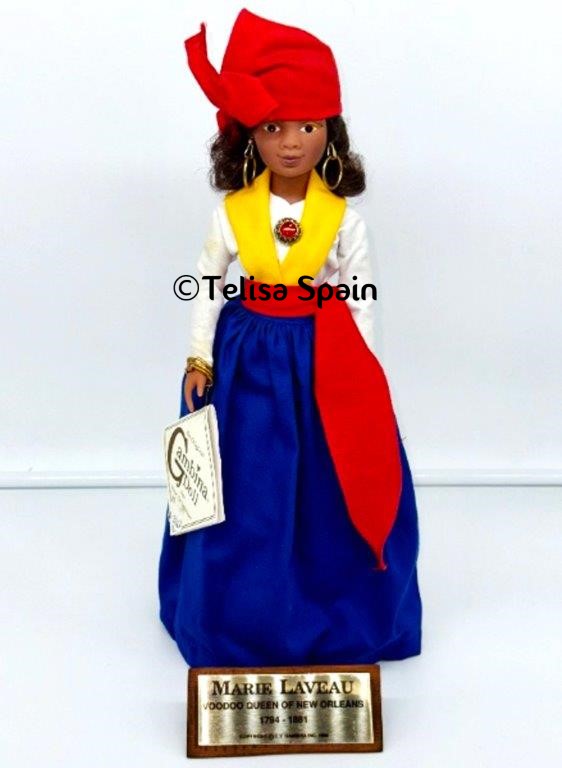
“MARIE LAVEAU (1794-1881) Voodoo Queen Marie Laveau, a free mulatto, was born in New Orleans in 1794. Her father was Charles Laveau, believed to be a white planter, and her mother was a woman believed to be part Indian and mulatto, which is a mixture of Negro and White blood. At age 25, in 1819, Marie married Jacques Paris, a free man of color. They were married at the St. Louis Cathedral by Pere Antoine. Less than 3 years later, Jacques left Marie and returned to Santo Domingo where it is believed he died. Marie then took the title of “veuve (widow) Paris”, which is inscribed on her tomb.
“In 1826, at age 32, Marie and a quadroon (¼ Negro blood) Capt. Louis Christophe de Glapion began living together as man and wife. They had 15 children, but were never married. This relationship lasted until his death in 1855. He is buried in the Laveau tomb.
“It was also in 1826 when Marie decided to make voodoo a profession. She wanted to be the only voodoo queen so she forced the other queens to step down, either by force or fear of her powers. She did not hesitate to beat them up if they refused. Because she was hairdresser to the elite white women, Marie was able to get a lot of information. They talked freely to her and she used this to grant them favors with her voodoo. Her most important tool for being successful was one, Marie did not understand herself. She had the gift of mental telepathy. When they asked how she knew something would happen, she told them her knowledge came from the “high heavens” or “gris gris.” Though she was ignorant, educated people would come to her for advice on personal and political matters. They didn’t understand her gift either but they knew she could foretell the future and read minds. Marie’s gris gris was powerful. Some people thought she was good while others thought she was evil. Everyone feared her. She would make, and sell, all sorts of potions and charms to help people get what they wanted. She believed if she did something bad to one person, it was good for someone else. This seemed to balance things in her mind.
“For using her gris gris to help a young man get acquitted in a court case, Marie was given a house on St. Ann Street by the grateful father. She lived in this house for 50 years. Her voodoo rituals were held in the back yard on St. Ann St. once a week. She dared to mix the voodoo of Haiti (devil worship) with Christianity. Marie was very clever. She knew that in order to be successful she must have something for everyone. Showmanship was essential. During the rituals, having downed a goodly amount of rum and whiskey, the participants would dance themselves into hysteria. It always ended with dancers half naked, crying, fainting, praying, or having orgies. Marie started the dancing with her snake god, Zombi, then sat down and let the others dance. Many white people were spectators but were always masked or disguised so they would not be recognized.
“Marie went to the St. Louis Cathedral every day and was a devout worshipper. She nursed the sick free of charge, even those with Yellow Fever. She often visited condemned prisoners and sneaked potions to them to make their dying easier.
“Though she must have profited well from her voodoo, Marie never changed her poor lifestyle. Her only show of any wealth was the Ruby pin she used to close the front of her blouse and her gold hoop earrings and many gold bracelets. Marie loved red and disliked black. Her tignon was red and her skirt was always a dark color, mostly blue but never black. Her underclothing was a petticoat and mid-thigh pants made of osnaburg fabric.
“Marie Laveau died in her sleep in her house (that no longer stands) on St. Ann St. in 1881 at the age of 87. In her last years she renounced voodooism and was given a Catholic burial. She is buried in the St. Louis Cemetery #1. Many people today believe that Marie Laveau’s spirit still lurks about New Orleans practicing voodoo! © (The above text was copied from the doll’s hang tag booklet.)
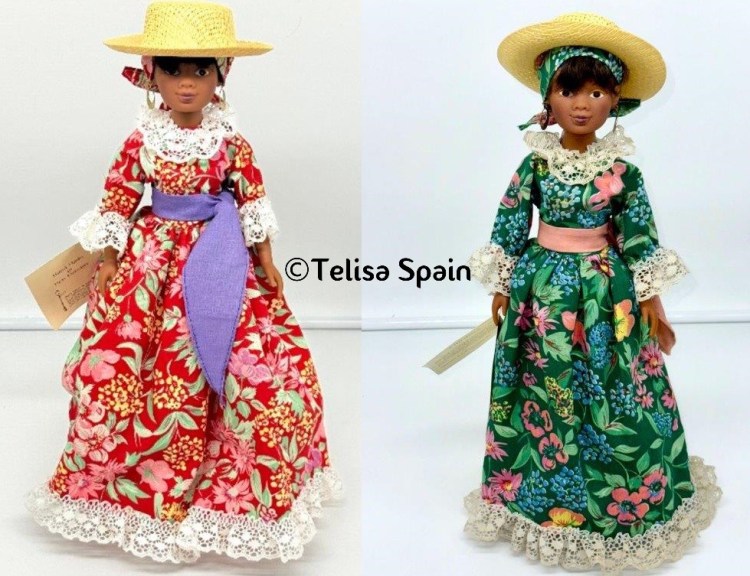
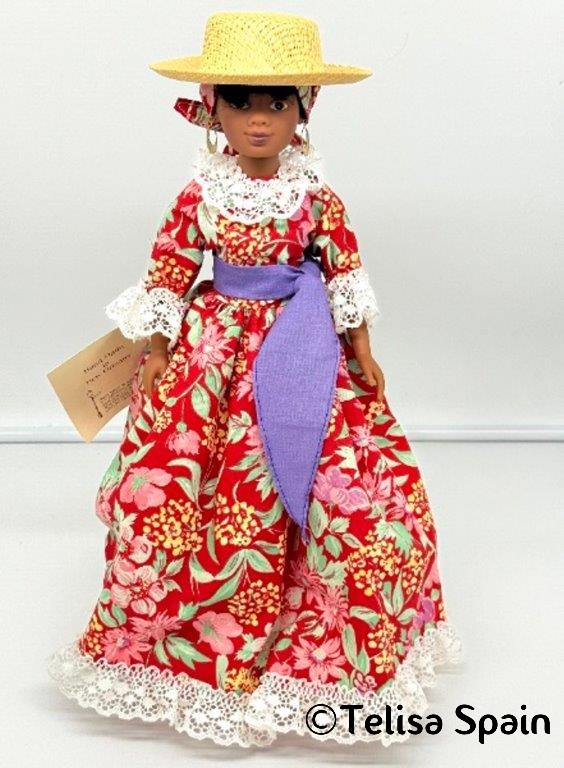
“VIRGINIA, circa 1850
“Long and airy dresses protect the Caribbean Island Women from the sun and sand. A colorful scarf and wide brimmed hat are worn to keep the head cool and the face shaded from the day long sun.
“Colorful and lovely Virginia represents those island beauties who have kept these traditions alive in their native lands and in their migrations around the globe.
“Copyright © C.V. Gambina, Inc. 1989
#131″ (The above text about Virginia was copied from the doll’s story card hang tag.)

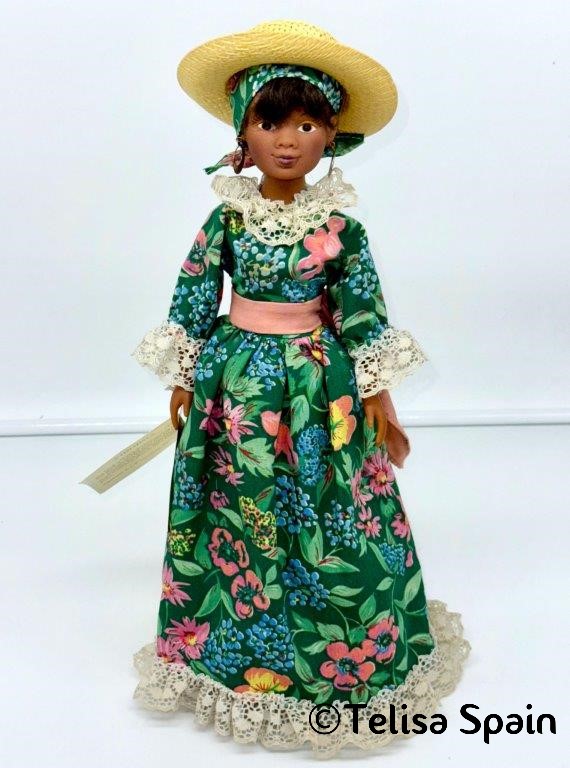
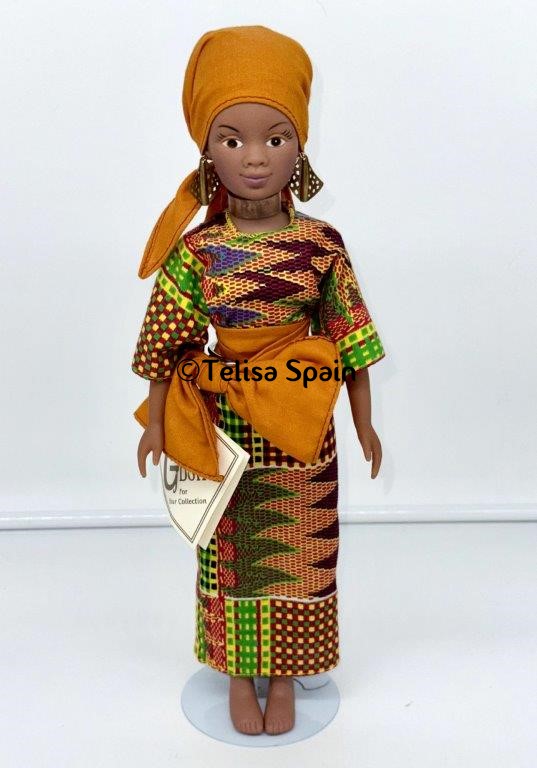
Lucina and African Lady Rema #137
LUCINA and AFRICAN LADY REMA represent Creole and African women, respectively.
Other: Marie Laveau and the other 14-inch vinyl dolls by Gambina represent Creole, Caribbean, African, and African American women of the 1800s. Created by Charles Vincent Gambino in New Orleans, Louisiana, each doll is numbered and has a hang tag booklet or story card that describes its period story. The company made 12- to 13-inch vinyl dolls that similarly depict historical and Southern-themed women of color from the company’s perspective. The vinyl dolls were made in Hong Kong and dressed in the U.S. Gambina also made cloth dolls with lithographed faces and yarn hair with multiple attached ribbons and some porcelain variations.
Gallery (Photos and descriptions courtesy of Telisa Spain)


_________
Your comments are valued. Donations support the initiative to preserve black-doll history.
If you subscribe to DeeBeeGee’s Virtual Black Doll Museum™ by email, click the post title of the email, which links to the website to view all text and associated media. Please “like” and share this installation with your social media contacts. If you’d like to subscribe, add your email address to the subscribe or sign-up field in the footer or right sidebar. Add your email address to the subscribe or sign-up field in the footer or right sidebar.
 DeeBeeGee's Virtual Black Doll Museum™