
Name: Unknown circa 1950s doll by Ratti
Made by and When: Ratti, circa 1950s
Material: Hard plastic
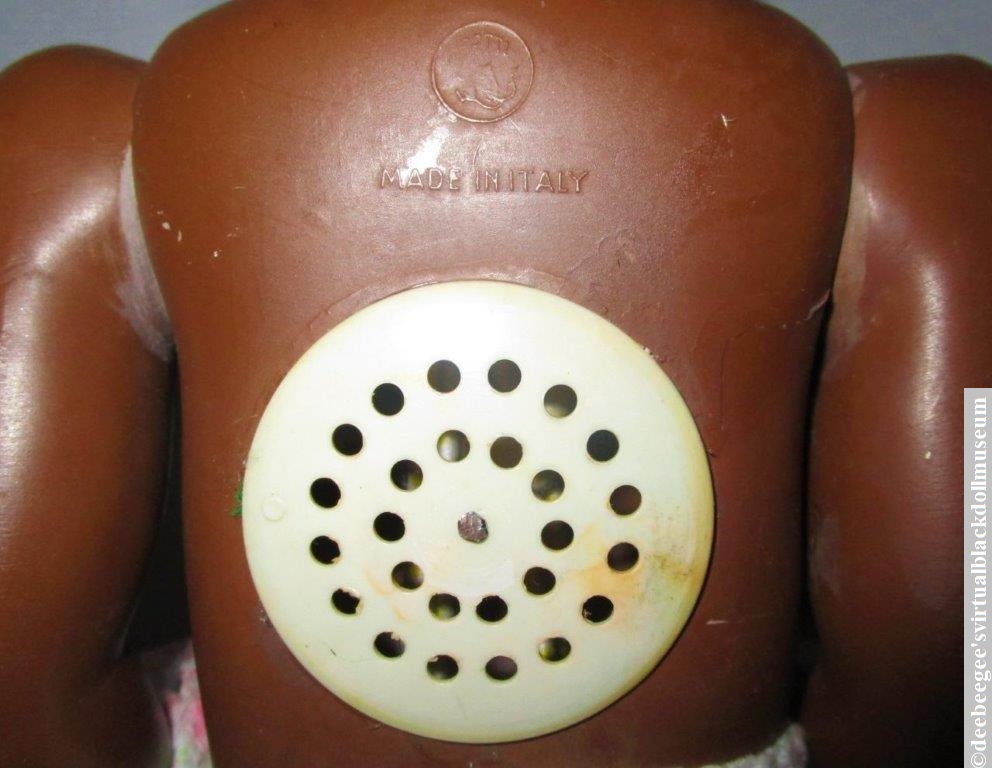
Marks: (Head) Inside a circle reads RATTI / Italia [with two side-by-side rats on their hind legs] / MADE IN ITALY / 50. (Upper Back) The same marks except Italia is not inside the circular Ratti mark and the number 50 is not on the upper back.
Height: 17 inches
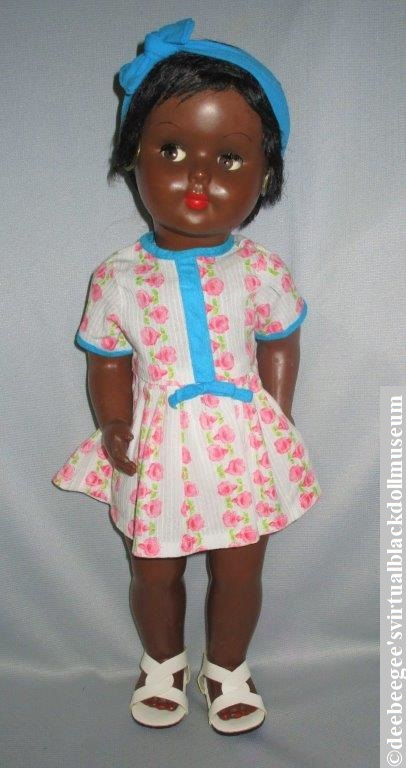
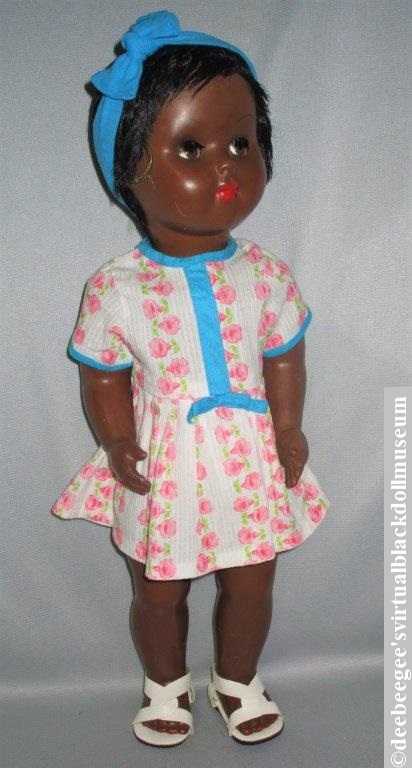
Hair, Eyes, Mouth: Short, black-rooted hair that has become brittle. The hair is now gelled into place to eliminate shedding. The scalp has manufactured black paint. Brown flirty eyes with eyelids and eyelashes, the eyelids are now inside the doll’s head after detachment from the eyes during shipping from Northwestern Europe to America. The mouth is closed with painted-red full lips.
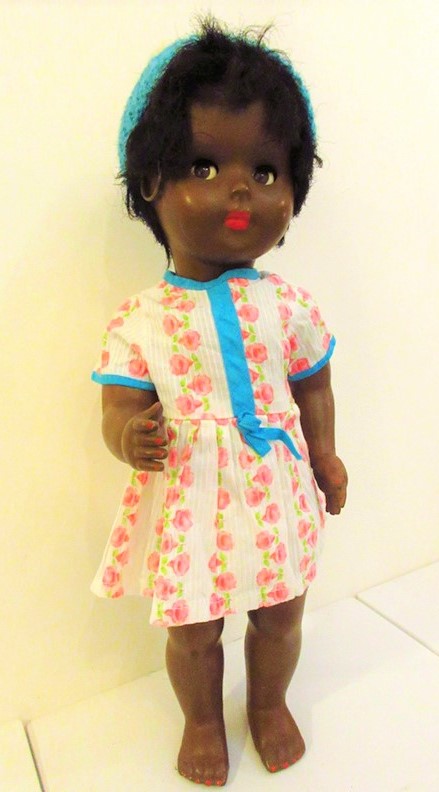

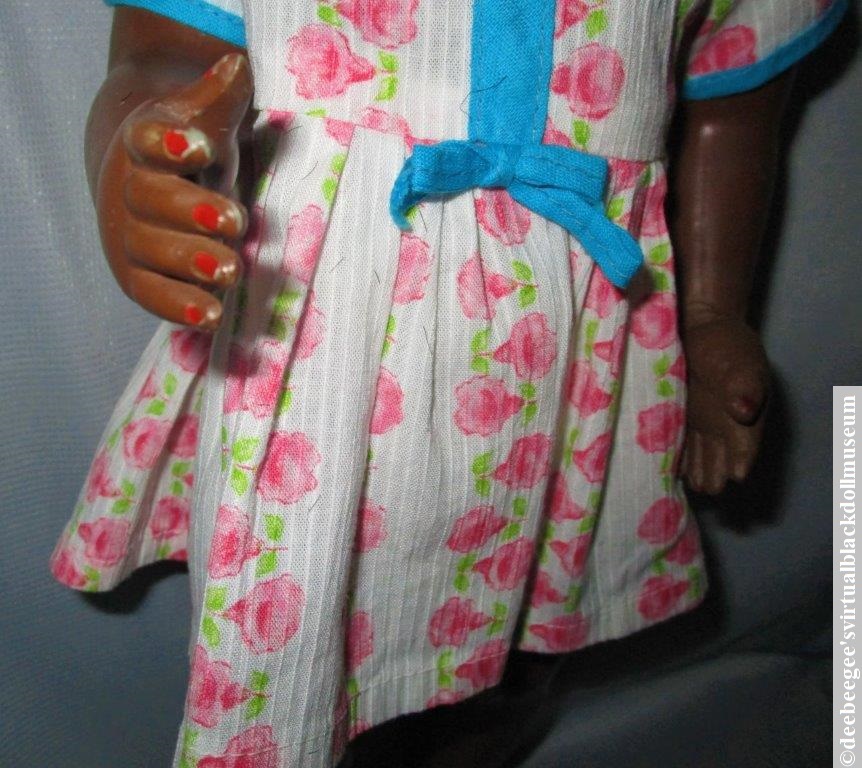
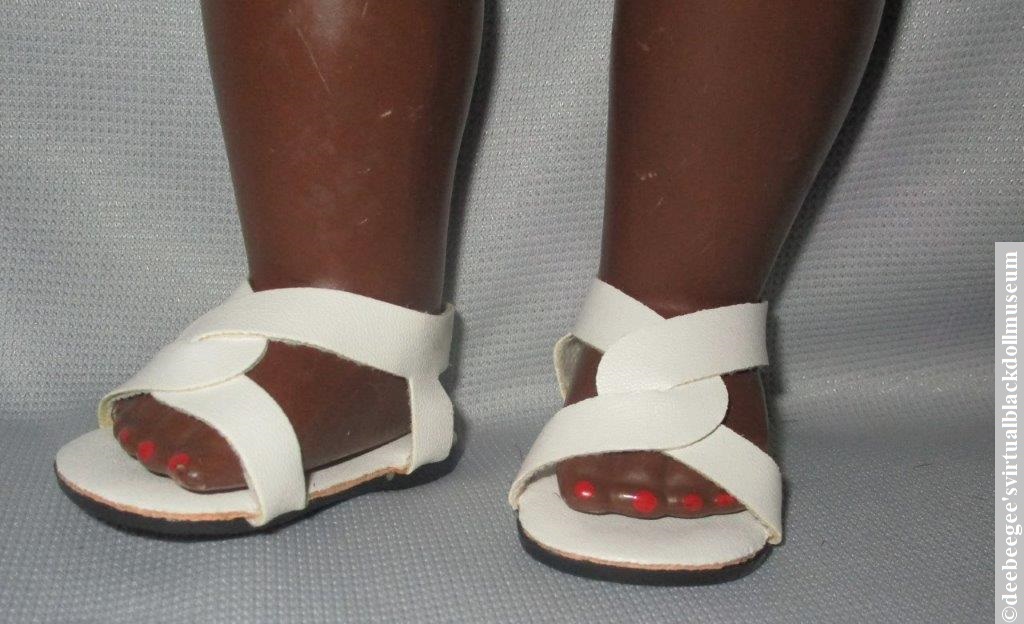
Clothes: Redressed in a period-appropriate dress, white crocheted panties, more modern white sandals, and an added turquoise headband. The original gold-tone hoop earrings remain sewn to the hair in the location of the ears.
Other: Made in Italy, this lovely doll has factory-painted fingernails and toenails and a non-working voice box in the middle of the back. It was donated to the museum by Jolie van der Klis of the Netherlands who purchased it from another woman in the Netherlands several years before the donation. The doll had been the original owner’s childhood doll. Based on the hoop earrings sewn to the hair, an African tribal garment might have been the doll’s original clothes.
Ratti Doll Company History (provided by Jolie van der Klis): Founded in 1913 by Antonio Ratti and Giovanni Vallenzaca, the company made wickerwork baskets in the early years. By 1919, Ratti and Vallenzaca along with Antonio’s son Augusto began making dolls and other toys. In the early 1930s, Ratti imported cardboard* doll heads from Germany but soon began making their own cardboard dolls marked Ratti. They switched from cardboard to modern materials—early plastics made from synthetic components like polystyrene and later polyethylene. Some of the early dolls are made of a grayish material that is spray painted afterward. The Ratti doll in this installation is made of that grayish material, which is thinner and not as sturdy as the American-made hard plastic dolls of the 1950s. The company began making vinyl dolls in 1953 (this rigid plastic doll’s origin, thus, precedes that year). That same year, Gianni Ceppi, son-in-law of Antonio Ratti, took over doll manufacturing. See the timeline of the Ratti company below the gallery photographs.
Gallery




Timeline of Ratti Company
Date / Event
1913 / The firm begins in Arona. (Province of Novara) at the initiative
of Antonio Ratti (press importer) and Giovanni Valenzasca (Banker). A
modest production of teddy bear animals filled with wood chips. Then
make papier-mâché horses and finally dolls.
1919 / Following the 1919 crisis, a subsidiary was founded in Michelau
in Bavaria, then a second subsidiary in Feverth near Nuremberg: The
Tedesco Center for construction of toys.
1920 / Takes part in the first “Fiera” in Milano to survey the Italian
market.
The firm was then dependent on a toy factory in Milan specializing in
dolls, which worked with sculptor Giovanni Panunzio, creator of
porcelain-headed dolls and others in wood.
Production took place in branches in Torino and Milan until 1930-31.
1930 – 1931 / Then began the marketing of dolls with papier-mâché heads,
imported from Germany at the beginning, then made on site.
1931 / Augusto Ratti son of Antonio Ratti takes over the management.
Then began a production of dolls with *cardboard heads imported from
Germany, at the beginning, then made on site.
Birth of an “all Italian” doll and start of industrial production.
After a year gives work to more than 400 people.
In a short time the production reaches 1000 heads per day.
A department store: “Rinacente-Upim e Dtanda” orders a total of 350,000
pieces per year!
1939 / The record figure of 987,350 dolls is reached this year; Almost
all produced for the Italian market.
1945 / After business interruption due to the World War, the brand
reappeared in department stores.
1946 / Export to neighboring Switzerland in an unusual way: Sellers and
buyers meet at the customs of the “Piaggio Valmara” at the place of the
doll championship where the deal was concluded.
1948 / With the Milan, Brussels and Casablanca fairs, the Ratti doll
became known all over the world.
1950 / Production of dolls in polystyrene and soon after in polyethylene.
1953 / Begins manufacturing vinyl dolls
Gianni Ceppi, son-in-law of Antonio Ratti, ensures the manufacture of
dolls, mignonnettes and babies dressed in various ways as well as the
“Damine” (young lady) with the “powdered” head and luxuriously dressed,
doll of good quality, which allowed it is up to some of them to arrive
in good conditions.
The plastic dolls of the brand are marked at the base of the neck with
the mention Ratti accompanied by the figurine representing two little mice.
Around 1960 / Release of ‘carrot hair, Spinaccina,
1969 / The firm Ratti e Vallenzasca ends with the sale to the American
firm: Mattel S.p.a.
Reference
http://genyanddolls.over-blog.com/article-mutine-poupee-ratti-119405946.html
_________
Your comments are valued. Donations aid the initiative to preserve Black-doll history.
If you subscribe to DeeBeeGee’s Virtual Black Doll Museum™ by email, be sure to click the post title in the email, which links to the website to view all text and associated media. Please “like” and share this installation with your social media doll contacts. To subscribe, add your email address to the subscribe or sign-up field in the footer or right sidebar.
 DeeBeeGee's Virtual Black Doll Museum™
Hi Debbie,
I am thrilled, that is such a lovely post!
I just tried to respond, but for some reason, even om my newest laptop, I cannot reply.. (It probably has got to do with my laptop, or the spam-protection, I often have problems replying to WordPress-blogs, but it worries me that I even have them only newest laptop now ;-/) (I am sort of ‘lost’ trying to figure it out ;-/)
So I’ll send you my comment, and maybe you can post it underneath the Post…?
I’ll ask my husband for help later.. (he’s going to visit his Mom who had an operation right now) but he often has got many solutions for computer-problems 😉
All the best from Hilversum! Hartelijke groetjes, Jolie
My comment: “It is SO nice to see she has survived the long trip to the USA, and that you managed to replace the lost eyelashes so well! Our parcel-service is not always very careful with the boxes, but I was afraid to damage the wig or head lifting the wig to fill up the head with paper..
Ratti dolls are all dear to me 🙂 They were the very first dolls my sister and I had as children, it is an honour to me this sweet doll has a place in your Museum now! (I thought about searching for the very first owner, to let her know too, but I bought her through a platform back then, it only rendered a temporary emailaddress.) All our childhood Ratty-dolls had names ending with the (Dutch) “-eaze”-sound, (so) her name would probably have been something like Louise. But of course, today she is too vulnarable to still be a ‘play-doll’ 🙂 Thank you so much for sharing these lovely photo’s!
Hartelijke groeten, Jolie ”
>
LikeLike
Hi Jolie!
I just emailed you after I revised the installation to let you know some of your pictures were used in it and to share the link. It pleases me that the installation pleases you. I am forever grateful that you entrusted me with this lovely, rare doll. She will always have a place in my collection and now will be forever in DeeBeeGee’s Virtual Black Doll Museum for subscribers and others who visit to admire and learn about. Thank you again!
Your miles-away doll friend,
Debbie
LikeLike
P.S. Jolie, I believe the original owner would be pleased with what we’ve both done with this lovely doll and how much pleasure she has given both of us.
dbg
LikeLike